- Buy Low, Sell High. Every month the Darkmoon Faire arrives in Azeroth or Outland, filled with all sorts of wild and wondrous artifacts to buy. You can get exotic leather, strange herbs, motes and gems for dirt-cheap prices. And you should, too. Devote an alt to camping out by the Faire booths. Make sure they have plenty of money and inventory space, and check periodically throughout the day. Stock up throughout the week, and then, when the Faire leaves, run to the Auction House and sell everything you don't need for a higher price. Darkmoon Faire rotates between Mulgore, Elwynn Forest, and Terokkar Forest. This month, it's visiting Elwynn, just outside of Goldshire.
- Learn the Zen of the Auction House. Almost any item you find on your travels is worth something to someone, and the best time to sell it is from Friday evening through Sunday night at the Auction House. Prices skyrocket during the weekend. And the higher player volume means that it's much easier to sell more expensive blue or purple items without having to dig deep for the auction deposit; most items sell within 12 hours. Remember: never sell an item if someone else is selling a ton of it. Undercutting someone is one thing, but the more there is in the AH, the less demand there is on the market. That said, undercutting, or selling the same item for just a little bit less than the competition, is encouraged, as long as it doesn't take a bite out of your profits.
- Find a Worthy Profession. I'm sure it's possible to make it to level 70 without two high-level professions, but frankly, I wouldn't ever want to try it. Pick your professions early and stick with them. Keep a list of where to find raw materials, and another list of how much things sell for in the Auction House - that'll give you some backup when in 40 levels you can't remember how much mithril filigree should cost. And sell things all the time, because most professions do pay if you devote enough time to them. If you're absolutely desperate to change professions, try to keep at least one of your originals so you don't completely re-invent the wheel (e.g. try switching from Jewelcrafting to Engineering while keeping your Mining profession). Or create an alt with complimentary professions who you can run through low-level areas stockpiling goods. Professions, unlike dungeon running, don't usually give you a ton of money at a time, but all that selling does add up, and having a high level profession of any sort means you can make friends in high places in later levels.
Sunday, December 7, 2008
Quick Tips: Making Money
Finding your pocketbook a little empty? Need cash for that epic mount? Want to buy a sharp new weapon in the Auction House? Here are some basic tips that may not help you "get rich quick," but which can certainly help you put away some gold for a rainy day.

The Headless Horseman's Carpet

When I signed up for that rug-weaving class, I thought it was to make a carpet for me, not my horse! Tailors who possess both the Flying Carpet and The Horseman's Reins will be glad to know that they can ride both mounts at the same time, due to a strange bug which doesn't seem to differentiate between the two.
It seems that the Horseman's steed is the only mount to which this bug applies. But now creepy undead horses everywhere can enjoy comfortable, 230-thread-count, high-speed travel, without all the saddle sores. I just hope it's machine washable.
Professions for a Newer, Colder Continent

Forget Glyphs, what today's adventurers really need as they brave the cold environs of Northrend is a nice warm scarf. Today, a look at plausible professions we haven't seen in-game.
Knitting. From frost-resistant scarves to reinforced hats and fuzzy, woolen socks, adventurers have all sorts of options for staying warm and dry as they explore Northrend. Unlike tailoring, knitting would fill the custom character equipment slots of hat, scarf, mittens, and socks.
Tattooing. Like Enchantment, but for your character's skin, tattooing would open up a new level of character customization. Not only could you choose your own distinctive tattoo, but each tat could impact spells and abilities, add to base stats, or give your character extra resistances to magic.
Brewing. Everyone loves making unusual and distinctive dishes via the Cooking profession (not to mention meals which add to base stats, resistances, or health and mana regeneration), but there are very few beverage options available to today's cooks. What about a profession which allowed you to brew your own ale, ferment your own wine, or blend your own tea? Despite the obvious amusement of making your character tipsy by your very own alcoholic beverages, each drink could bring its own benefits, like restoring mana, giving a short-term magic buff, or increasing the drinker's base stats.
Is there a profession you wish Blizzard would add to the game? Tell us about it in the comments below.
The Newbie’s Guide to Strand of the Ancients
Just entered your first Strand of the Ancients battleground? Unsure what to do, or why there are huge cannons firing at you, or how to drive those weird tanks? We’ve got you covered.
What is Strand of the Ancients? This battleground is a two-phase timed siege conflict set against the backdrop of an ancient Titan fortress. The Strand is unique in that it features player-driven siege vehicles, much like those used in Wintergrasp, and player-controlled anti-personnel cannons.
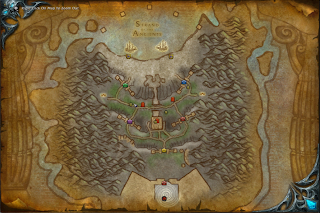
In Phase one, Horde defends the fortress from Alliance attackers. The attackers have a total of nine minutes and 55 seconds to blast their way through the fortress gates and reach the Keep to capture the Titan relic held therein.
In phase two, Horde goes on the offensive while the Alliance defends the fortress. If in phase one the Alliance attackers are able to capture the relic before their time has expired, then their attack time becomes the total time the Horde have in phase two to reach the relic. This means that , like most battlegrounds, timing and strategy are key if your team wants to win.
Step One: Defense
The name of the game here is: Gate Control. There are a total of five outer gates and an inner keep gate in Strand of the Ancients, each of which can be destroyed by the attacking team. You’ll start battle high up on the South Graveyard platform facing the first two fortress gates, which overlook the beach and the arrival of your attackers. Usually, defenders will divide here, sending half their team to one gate and the other half to, well... the other gate. The first players to arrive usually take control of their gate’s turret cannons, while any additional defenders patrol the area.
Without a doubt, the most fun part of being a defender is using the huge antipersonnel cannons which overlook each of the first four fortress gates. Each gate has two cannons, and defenders would be wise to ensure that the cannons at both starting gates are fully-staffed. If you’re the first to reach a cannon, dismount and hop inside. Immediately, your character ability hotbar will be replaced by a hotbar for the cannon itself. There’s only one ability to master here, so spam it to your heart’s content. The cannons also come with a targeting display, which you can use to determine where your next shot will land.
The most important role for a player in control of a cannon is to take down the enemy Demolishers (huge siege vehicles) before they have a chance to break their way through your gate. Both siege vehicles and cannons have a separate health rating than their operators and are disabled first, so upon destroying a Demolisher, make sure you fire some shots into the wreckage to take out the enemy pilot and potential passengers as well. But beware – Demolishers have a long range and are capable of destroying antipersonnel cannons as well as the gates themselves.
Should the enemy break their way through, fire a few parting shots and make your way to the second pair of gates. If at any time a defender is caught on the wrong side of an unbroken gate, they can use the Defender Portals located nearby to teleport to safety.
As the battle moves to the second set of gates, cannon operators should also pay special attention to invaders attempting to take control of the nearby graveyard flags. Once your graveyards have been taken, they cannot be reclaimed. Furthermore, possession of these graveyards also activates the siege workshops nearby, allowing enemy players to bring more Demolishers into the battle, as well as Seaforium Charges, which individual players can use to help destroy gates. The good news is that compared to your antipersonnel cannon, any enemy attempting to take over a flag is relatively weak.
Only one player can use a turret cannon at a time, but fortunately there’s a lot to do when you’re defending, even if you don’t have access to the heavy artillery. In the beginning of the battle, defending players not on cannon duty commonly swarm the beaches, looking to distract Demolisher drivers and take out wandering enemies.
Once the battle reaches the second set of gates, attacking players have access to Seaforium Charges, which are personal bombs used to help destroy the fortress gates. Players bearing Seaforium Charges can usually be identified by their pell-mell run towards the fortress gates, ignoring enemy cannon fire. Defenders not on cannon duty should disarm the Charges as fast as possible to avoid incurring damage to their gate.
The fifth fortress gate does not possess antipersonnel cannons, so defenders here will be required to take on Demolishers hand to... wheel? battering ram? catapult? Demolishers look slow but they can move out of spell range quickly. They also cannot be slowed, frozen or snared. Your best bet in bringing them down is therefore to run behind or alongside them and hit them with the best instant-cast and quick-timed abilities you’ve got. Don’t run directly in front of a Demolisher, as they have a battering ram ability which causes significant damage.
Should enemy attackers break through the fifth gate, defenders should spare no energy in halting their siege on the fortress keep. Attackers have only to click on the Titan relic inside the keep to claim it, and their attack time will become yours unless you can prevent them from gaining access to the keep.
Step Two: Attacking
Your attack starts aboard one of two ships sailing toward the Strand. Attackers, just like defenders, are divided at the start of the phase. Use this time aboard the ship to plan your strategy and determine your Demolisher operators. Both attacking ships will land at separate docks, each of which harbors two Demolishers, which provide the starting artillery to make your first assault on the enemy gates.
When a player takes control of a Demolisher, their task bar is replaced by the abilities bar of the Demolisher itself. These siege engines have two abilities - a long-range catapult shot for taking our enemy gates and turret cannons, and a short-range battering ram for knocking down doors and making melee-range strikes against any enemy players. Like the anti-personnel cannons, Demolishers come with a ranged targeting display to help plan where your shots will land.
Each Demolisher can hold two passengers, and unlike the driver each passenger is free to use their character abilities while riding the siege engine. Passengers are too far away to use melee combat skills, however, so the standard attack philosophy is to have melee fighters drive the Demolishers while players with ranged combat abilities act as passengers.
While they pack a lot of fire power, Demolishers are relatively unwieldy in close-range combat. They are slow to turn, and completely undefended against side or rear attacks. It should therefore be the job of the passengers in any Demolisher to pick off nearby enemies before they can become a nuisance. Should your Demolisher be destroyed by enemy forces, a new one will respawn on the beach, or in any siege workshops your team controls.
Attackers who are not operating a Demolisher have various options during combat. They can run interference, distracting defenders who are trying to take down Demolishers. Should one gate be breached before another, they can sneak around the back of the defending cannon turrets and begin taking down the antipersonnel cannons at melee range with relative impunity. Or, after the first set of gates have been destroyed, they can take over one of the enemy graveyards and begin arming Seaforium Charges – personal bombs found inside the barrels stockpiled outside each workshop.
When running Seaforium Charges, it’s usually best to have company. As the battle moves closer to the keep, defenders become more numerous (and usually more frantic as well), and the chances of them diffusing your bombs become higher. Grab and friend or three and storm a gate together to maximize your chances for damage. Remember that while you must dismount to pick up a Charge, you can mount and ride while carrying one.
While the keep gate and the fortress doors themselves do not have any cannons to protect them, defenders from both sides of the fortress usually converge at this point. This means that both Demolishers and attacking players will find themselves once more in melee range with defenders. Attackers who aren’t piloting or riding Demolishers or running Seaforium Charges must therefore take care to destroy or distract any enemies who are attacking your siege engines. Demolishers remain your best hope of breaking through the fortress gates and capturing the relic.
Interested in learning more about Strand of the Ancients? Join me next time as I take a look at some of the more interesting battleground achievements. Good luck!
What is Strand of the Ancients? This battleground is a two-phase timed siege conflict set against the backdrop of an ancient Titan fortress. The Strand is unique in that it features player-driven siege vehicles, much like those used in Wintergrasp, and player-controlled anti-personnel cannons.

In Phase one, Horde defends the fortress from Alliance attackers. The attackers have a total of nine minutes and 55 seconds to blast their way through the fortress gates and reach the Keep to capture the Titan relic held therein.
In phase two, Horde goes on the offensive while the Alliance defends the fortress. If in phase one the Alliance attackers are able to capture the relic before their time has expired, then their attack time becomes the total time the Horde have in phase two to reach the relic. This means that , like most battlegrounds, timing and strategy are key if your team wants to win.
Step One: Defense
The name of the game here is: Gate Control. There are a total of five outer gates and an inner keep gate in Strand of the Ancients, each of which can be destroyed by the attacking team. You’ll start battle high up on the South Graveyard platform facing the first two fortress gates, which overlook the beach and the arrival of your attackers. Usually, defenders will divide here, sending half their team to one gate and the other half to, well... the other gate. The first players to arrive usually take control of their gate’s turret cannons, while any additional defenders patrol the area.
Without a doubt, the most fun part of being a defender is using the huge antipersonnel cannons which overlook each of the first four fortress gates. Each gate has two cannons, and defenders would be wise to ensure that the cannons at both starting gates are fully-staffed. If you’re the first to reach a cannon, dismount and hop inside. Immediately, your character ability hotbar will be replaced by a hotbar for the cannon itself. There’s only one ability to master here, so spam it to your heart’s content. The cannons also come with a targeting display, which you can use to determine where your next shot will land.
The most important role for a player in control of a cannon is to take down the enemy Demolishers (huge siege vehicles) before they have a chance to break their way through your gate. Both siege vehicles and cannons have a separate health rating than their operators and are disabled first, so upon destroying a Demolisher, make sure you fire some shots into the wreckage to take out the enemy pilot and potential passengers as well. But beware – Demolishers have a long range and are capable of destroying antipersonnel cannons as well as the gates themselves.
Should the enemy break their way through, fire a few parting shots and make your way to the second pair of gates. If at any time a defender is caught on the wrong side of an unbroken gate, they can use the Defender Portals located nearby to teleport to safety.
As the battle moves to the second set of gates, cannon operators should also pay special attention to invaders attempting to take control of the nearby graveyard flags. Once your graveyards have been taken, they cannot be reclaimed. Furthermore, possession of these graveyards also activates the siege workshops nearby, allowing enemy players to bring more Demolishers into the battle, as well as Seaforium Charges, which individual players can use to help destroy gates. The good news is that compared to your antipersonnel cannon, any enemy attempting to take over a flag is relatively weak.
Only one player can use a turret cannon at a time, but fortunately there’s a lot to do when you’re defending, even if you don’t have access to the heavy artillery. In the beginning of the battle, defending players not on cannon duty commonly swarm the beaches, looking to distract Demolisher drivers and take out wandering enemies.
Once the battle reaches the second set of gates, attacking players have access to Seaforium Charges, which are personal bombs used to help destroy the fortress gates. Players bearing Seaforium Charges can usually be identified by their pell-mell run towards the fortress gates, ignoring enemy cannon fire. Defenders not on cannon duty should disarm the Charges as fast as possible to avoid incurring damage to their gate.
The fifth fortress gate does not possess antipersonnel cannons, so defenders here will be required to take on Demolishers hand to... wheel? battering ram? catapult? Demolishers look slow but they can move out of spell range quickly. They also cannot be slowed, frozen or snared. Your best bet in bringing them down is therefore to run behind or alongside them and hit them with the best instant-cast and quick-timed abilities you’ve got. Don’t run directly in front of a Demolisher, as they have a battering ram ability which causes significant damage.
Should enemy attackers break through the fifth gate, defenders should spare no energy in halting their siege on the fortress keep. Attackers have only to click on the Titan relic inside the keep to claim it, and their attack time will become yours unless you can prevent them from gaining access to the keep.
Step Two: Attacking
Your attack starts aboard one of two ships sailing toward the Strand. Attackers, just like defenders, are divided at the start of the phase. Use this time aboard the ship to plan your strategy and determine your Demolisher operators. Both attacking ships will land at separate docks, each of which harbors two Demolishers, which provide the starting artillery to make your first assault on the enemy gates.
When a player takes control of a Demolisher, their task bar is replaced by the abilities bar of the Demolisher itself. These siege engines have two abilities - a long-range catapult shot for taking our enemy gates and turret cannons, and a short-range battering ram for knocking down doors and making melee-range strikes against any enemy players. Like the anti-personnel cannons, Demolishers come with a ranged targeting display to help plan where your shots will land.
Each Demolisher can hold two passengers, and unlike the driver each passenger is free to use their character abilities while riding the siege engine. Passengers are too far away to use melee combat skills, however, so the standard attack philosophy is to have melee fighters drive the Demolishers while players with ranged combat abilities act as passengers.
While they pack a lot of fire power, Demolishers are relatively unwieldy in close-range combat. They are slow to turn, and completely undefended against side or rear attacks. It should therefore be the job of the passengers in any Demolisher to pick off nearby enemies before they can become a nuisance. Should your Demolisher be destroyed by enemy forces, a new one will respawn on the beach, or in any siege workshops your team controls.
Attackers who are not operating a Demolisher have various options during combat. They can run interference, distracting defenders who are trying to take down Demolishers. Should one gate be breached before another, they can sneak around the back of the defending cannon turrets and begin taking down the antipersonnel cannons at melee range with relative impunity. Or, after the first set of gates have been destroyed, they can take over one of the enemy graveyards and begin arming Seaforium Charges – personal bombs found inside the barrels stockpiled outside each workshop.
When running Seaforium Charges, it’s usually best to have company. As the battle moves closer to the keep, defenders become more numerous (and usually more frantic as well), and the chances of them diffusing your bombs become higher. Grab and friend or three and storm a gate together to maximize your chances for damage. Remember that while you must dismount to pick up a Charge, you can mount and ride while carrying one.
While the keep gate and the fortress doors themselves do not have any cannons to protect them, defenders from both sides of the fortress usually converge at this point. This means that both Demolishers and attacking players will find themselves once more in melee range with defenders. Attackers who aren’t piloting or riding Demolishers or running Seaforium Charges must therefore take care to destroy or distract any enemies who are attacking your siege engines. Demolishers remain your best hope of breaking through the fortress gates and capturing the relic.
Interested in learning more about Strand of the Ancients? Join me next time as I take a look at some of the more interesting battleground achievements. Good luck!
Saturday, December 6, 2008
Roleplaying: Going Against the Racial Stereotypes of Gnomes, Tauren, and Orcs
While the jokes, /flirt emotes, and dances each race has are fun to use, and often add a bit of fun to an hour or two of play, they are often an odd, if not contradictory addition to roleplaying sessions. This is because roleplaying focuses so intently on building your character’s own unique personality, their likes, dislikes, history, and raison d’etre. Often, the stylized, predictable and sometimes downright weird canned phrases that each character comes with seem false and generic.
But, perhaps even more important in a roleplaying environment, the basic character emotes provided by /silly or /flirt embody Blizzard’s stereotype of what each character race is. And in the vastly diverse realm of roleplaying, where your only limitations should be your own imagination, stereotypes are the last thing your character needs.
Not every Gnome is happy-go-lucky, and not every Troll says “ya, mon.” This multi-part roleplaying guide will cover some of the more pervasive racial stereotypes in the game and points players towards some NPC characters who contradict that stereotype and should therefore be good for researching and preparing to play a character who goes against the grain. Today, we focus on Tauren, Gnomes, and Orcs.
Stereotype: The Back-to-Basics Tauren. When your only class choices are druid, hunter, warrior, or shaman, it’s to be expected that you’re the earthy type. Perhaps more than any other race, Tauren are depicted as being at one with nature, and living within the cycle of what they call the Great Hunt. Even the infamous Grimtotem clan fall into this stereotype – they are corrupt but use the forces of nature to achieve their ends. And the racial attributes of the Tauren further reinforce that point:
But, perhaps even more important in a roleplaying environment, the basic character emotes provided by /silly or /flirt embody Blizzard’s stereotype of what each character race is. And in the vastly diverse realm of roleplaying, where your only limitations should be your own imagination, stereotypes are the last thing your character needs.
Not every Gnome is happy-go-lucky, and not every Troll says “ya, mon.” This multi-part roleplaying guide will cover some of the more pervasive racial stereotypes in the game and points players towards some NPC characters who contradict that stereotype and should therefore be good for researching and preparing to play a character who goes against the grain. Today, we focus on Tauren, Gnomes, and Orcs.
Stereotype: The Back-to-Basics Tauren. When your only class choices are druid, hunter, warrior, or shaman, it’s to be expected that you’re the earthy type. Perhaps more than any other race, Tauren are depicted as being at one with nature, and living within the cycle of what they call the Great Hunt. Even the infamous Grimtotem clan fall into this stereotype – they are corrupt but use the forces of nature to achieve their ends. And the racial attributes of the Tauren further reinforce that point:
- Tauren receive +15 to their Herbalism skill. That’s right – they’re naturally better at picking flowers than any other race.
- Tauren receive a 2% hit resistance against all Nature damage spells.
- Fleet Master Seahorn: This loyal second to Baron Revilgaz not only looks good in a pirate hat, he leads the navy of the Blackwater Raiders, a position which suggests more cunning than spirituality.
- Mr. Smite: First mate under Captain Greenskin, this evil Tauren patrols the docks of the hidden Defias Brotherhood fleet in the Deadmines. Clearly, he is not in his position to commune with the Earth Mother.
- Magatha Grimtotem: Inscrutable and irascible, Magatha is the Elder Crone and leader of the nefarious Grimtotem clan, despite which she makes her home in Thunder Bluff and is an advisor to Cairne Bloodhoof. There’s a huge can of worms right there for any aspiring Tauren looking to distinguish themselves.
- Gnomes are incredibly intelligent. They get a 5% racial bonus to intelligence, making them the smartest playable race in the game.
- Gnomes have natural mechanical aptitude. Engineering is one of the hardest professions in the game, and Gnomes are the best of the best at it. They receive +15 to their engineering skill.
- Sicco Thermaplug: Mad inventor, devious politico, self-proclaimed High Tinker of Gnomeregan, Sicco Thermaplug is anything but endearing. His shrewd mechanical mind was responsible for the downfall of the Gnomes’ home city by flooding Gnomeregan with radiation, and, some say, letting the Troggs in in the first place. Try patting this Gnome on the head and telling him he’s cute.
- Chromie: It is probably no coincidence that when this particular member of the Bronze Dragonflight chose to manifest in humanoid form, she picked the intelligence and understanding of a Gnome. Short for Chronormu, Chromie the Gnome/dragon is sworn to preserve the timeline of Azeroth and keep it safe from the Scourge. She can be found in the Ruins of Andorhal, Western Plaguelands.
- Silas Darkmoon: Founder of the Darkmoon Faire, Silas is more cunning businessman than obsessed tinkerer, and more slick entertainer than goofy joker. And he seems to be successful – after all, the Darkmoon Faire is called the Greatest Show on Azeroth.
- Blood Fury, which sends the Orc into a rage, increasing all attack power and spell power for 15 seconds.
- Axe specialization, which increases Axe weapon skill by 5, probably left over from the days the Orcs spent chopping down elvish forests in the second and third wars.
- Garrosh Hellscream: Headstrong, even foolhardy, Garrosh challenged Thrall to a fight when the Warchief refused to enact a more aggressive plan and immediately make war against the Scourge in Northrend. He believes in quick and immediate action, despite warnings from Thrall and High Overlord Saurfang that strategy is just as important to the New Horde as strength in winning a war.
- Gul’Dan: Once-apprentice to Ner’Zhul, who went on to become the Lich King, Gul’Dan is credited with being the very first Orc warlock, and responsible for introducing the Blood of Mannoroth to the Horde and opening the Dark Portal to Azeroth. Players can see Gul’Dan’s shade in Shadowmoon Valey at the Altar of Damnation.
- Greatmother Geyah: Thrall’s grandmother Geyah is the spiritual leader of the Mag’har, the last uncorrupted Orcs remaining on Draenor.
PvP Analysis: Tips for Arathi Basin Weekend

While Wrath of the Lich King brought us the shiny new battleground of Strand of the Ancients, firing cannons and driving siege engines shouldn’t take up all your battleground time. The original battlegrounds offer a quick way to gain some honor, especially if you play them during their holiday weekend. If it’s been awhile since your last Arathi Basin game, take a look at these tips before entering the battleground.
Guard! One player minimum per flag, preferably more. Really, there should never be a reason to break this rule, even at the starting flags of Farm or Stables. Not only does having a guard at every flag help to keep you informed of incoming enemy attacks, having a lookout often deters wandering flag ninjas from taking over your base. All it takes to lose a flag is one enemy – don’t give your opponents the chance.
Call It Out! Don’t let an enemy steal your flag in silence – if someone’s attacking, tell your team! The more information your team has, including the number of players attacking and their levels and classes, the more likely they are to be able to mount a quick defense. But at the very least, a quick “inc LM” can at least let your team know you need help.
Relief! Let’s face it: no one really likes guard duty. Guarding the flag is usually boring compared to the high combat that offensive players get to enjoy. Guards also get very little in the way of honor for protecting rarely-attacked flags. But they have a very important job. Sometimes numbers alone will deter an enemy from attacking a flag. Guards can therefore help your team not so much by seeking out enemy players to kill in the field, but by being pro-active in their flag defense. Nevertheless, guarding is often a thankless occupation, and even the most committed guard has days when they’d rather be out bonking heads than doing stealth detection at the Gold Mine. It’s often a very nice present for a player on offense to relieve a player stuck guarding a flag.
Take a Look. Often defenders are in a unique position to see the battleground at large. Blacksmith and Lumber Mill guards especially should use their vantage points to keep tabs on the battle and to call out incoming enemy parties not only at their own flag, but at other key strategic points. Reports on enemy numbers, on poorly-defended flag-points, and on changes in enemy strategy can give your team the information they need to win. Don’t be afraid to use abilities and items which give you a better perspective on the battle. Hunters have Eyes of the Beast, Tracking, and Eagle Eye. Druids and Rogues have Stealth. Engineers can make an Ornate Spyglass – a remarkable telescopic device which players of any profession can use.
Knockback in the Basin. It seems like everyone’s got a knockback ability these days. From Typhooning druids to mages with Blast Wave to shaman summoning Thunderstorm to hunters and their pets, battleground players should expect to be on the receiving end of knockback abilities on a regular basis from here on out. Anyone who has ever been Mind Controlled by a priest knows that in PvP one of the primary functions of knockback or any ability that allows one player to take control of another is to send one’s opponents careening over the edge of a very tall cliff, thus removing them from combat. In Arathi Basin, the Lumber Mill cliff is a prime spot for just this sort of maneuver. Just be careful not to get too close to the edge, or you might wind up getting knocked off yourself.
Have a happy, safe, and successful Arathi Basin weekend!
Why the Return of Naxxramas is a Good Thing

When the great floating citadel of Naxxramas retreated to Northrend, there was a general outcry among experienced raiders used to seeing it in the Plaguelands. “We’ve already been to Naxx,” they cried, “and now you’re going to make us do it again?” Old-school raid purists were even more miffed when they discovered that unlike its previous 40-man raid incarnation, Naxxramas was now tweaked to allow 25- and even 10-man raids to plumb its darkest corners and discover its best-kept secrets. “Stop! You’re running it!” they screamed, “Give us back old Naxx! Send it back to the Plaguelands, where it belongs!”
But amidst these screams of frustration and howls of rage was another sound, from a different demographic of the Blizzard community. It was the sound of satisfaction, and it was a sound being emanated from every single person who had never had a chance to set foot in Naxxramas before. I was one of those satisfied denizens of WoW, and I’m here to tell you why the return of Naxxramas is a very good thing indeed.
Casuals never saw it. People who didn’t want to invest the time required to get the necessary gear, make the masses upon masses of friends, and spend hours coordinating strategies and developing theories and setting their noses to the grindstone for hours on end to get attuned with Argent Dawn to even enter the instance have never seen Naxxramas. Now, they can.
People who joined post-BC never saw it. After Burning Crusade launched it was nearly impossible to get a 40-man raid together to run old-world instances, people were so busy exploring the wonders of Outland. As a post-BC WoW convert, to me, Naxxramas was something which always sounded cool, but which was unattainable. Now, my guild, which is composed mainly of people who started playing post-BC have a chance to see this legendary content.
Encounters have been rebalanced. Naxxramas has been rebalanced to consider the plethora of new level 80 abilities, and the new game class of Death Knight. This means that the Naxxramas we’re seeing at level 80 has been modernized. While some would call this a bad thing, I can only call attention to other old-world dungeons and raid encounters, like Dire Maul, Maraudon, Molten Core or Ahn'Qiraj. On my server, these instances are ghost-towns, because the mobs, bosses and loot therein have not been updated to keep pace with all the new character abilities. But Naxxramas has been saved a long, slow demise from lack of use by its new retune.
Is it a bad thing that what has been called one of the greatest instances in the game should see a new coat of paint and a location change? Is it bad that Blizzard is “reusing” content? In my book, not at all. See you soon, Patchwerk!
Subscribe to:
Posts (Atom)

